Sentence Structure

Sentence Structure
Having learnt the parts of speech in the English language, not knowing how to use them and where to place each part of speech to form a sentence would not be ideal. Right? In fact, sentence structure is one among the most important grammatical components that acts as the foundation of a language. So here is what you need to know. In this article, you will learn what a sentence structure is and the different sentence structures. You will also find examples for every sentence structure that you can refer to. Also, try out the practice questions given.
Table of Contents
- What Do You Mean by Sentence Structure?
- Basic Parts and Components of a Sentence
- The Different Types of Sentence Structures in English Grammar
- Examples of Sentence Structure
- Check Your Understanding of Sentence Structure
- Frequently Asked Questions on Sentence Structure in English
What Do You Mean by Sentence Structure?
Sentence structure is a grammatical component that tells you exactly where and how each component of a sentence should be placed in order to blend and make sense. The Collins Dictionary defines sentence structure as “the grammatical arrangement of words in sentences.” In other words, the sentence structure is what defines the way a sentence will look and sound.

Basic Parts and Components of a Sentence
Before we look into how sentence structure works, we will have to first learn about the basic structure of a sentence and the components that make up a sentence.
Parts of a Sentence
A sentence, in the English language, consists of at least a subject and a predicate. In other words, a sentence should have a subject and a verb.
Subject
The subject can be a noun or a pronoun that does the action.
For example:
- The sun is shining.
- The sky is clear.
- Today is Wednesday.
Predicate
The verb is the action performed by the particular subject in the sentence.
For example:
- I love macaroni and cheese.
- Merin has a pet.
- Anusha can draw.
Components of a Sentence
Like a sentence has two parts, it has five main components that make up the structure of a sentence, and they are,
- Subject
- Verb
- Object
- Complement
- Adjunct
Now, let us look at each of these components in detail.

Subject
A noun that performs the action in a sentence is considered as the subject. It answers the question ‘who’ or in other words, a subject can be identified by asking the question ‘who’. A subject takes the first place in most cases, especially in declarative or assertive sentences.
For example:
- The child kept crying.
- Our school team won the match.
- My son is in the eighth grade.
- Hard work pays.
- No one came to the wedding.
Verb
In every sentence the most important word can be said to be the verb. A verb shows action or activity or work done by the subject. Remember that all verbs including main verbs, helping verbs, stative verbs and action verbs come under this category. Most often, verbs appear immediately after the subject.
For example:
- Neena is writing a letter.
- It was too dark.
- I feel tired.
- My phone is not working.
- Tarun’s dog ran away.
Object
An object is a noun or pronoun that receives the action done by the subject. Objects are of two types and they are,
- Direct Object
- Indirect Object
Direct Object
A noun or pronoun that receives the action directly is the direct object in the sentence. It answers the question ‘what’. Direct objects mostly appear immediately after the verb and are the primary objects in the sentence.
For example:
- Harry bought a new car.
- My mom made a cake.
- I met my friend.
- She knows all the songs.
- We watched a movie.
Indirect Object
An indirect object is a noun or pronoun that is a secondary object. It can be identified by asking the question ‘whom’. When there is an indirect object in a sentence, it is mostly placed after the verb and before the direct object.
For example:
- Vandhana gave Keerthana a cake.
- My mom bought me a new dress.
- I gave him a chocolate.
- They gave us coffee with breakfast.
- He lent his friend a pen.
Complement
The words required to complete the meaning of a sentence can be referred to as the complement of the sentence. A complement can be an adjective, a name, a position or a profession.
For example:
- It grew dark.
- He is a dentist.
- That’s her dog, Bruno.
Complements are further divided into two types based on which component it speaks about. The two types of complement are,
- Subject Complement
- Object Complement
Subject Complement
The complement which expresses the quality or identity or condition of the subject is called Subject Complement.
For example:
- She is a doctor.
- I am Sindhu.
- Nandhu is clever.
- The students are very excited.
- My brother is a teacher.
Object Complement
The complement which expresses the quality or identity or condition of an object is called Object Complement.
For example:
- They made her angry.
- The students elected Sreya the class leader.
- They named their daughter, Thara.
- Marley met her friend, Ryan.
- Nobody found the movie interesting.
Adjunct
An adjunct is a word or a phrase that gives more information about an action, an event, a quality and so on. In short, it can be said that these words can include adverbs and adverb clauses. Adjuncts can be identified by asking questions ‘when’, ‘where’, ‘why’, ‘how’, ‘how often’ and ‘to what extent’. When using adjuncts, keep in mind that adjuncts can be used in the beginning, middle or end of the sentence and that there can be more than one adjunct in a sentence.

Take a look at the following examples to understand how adjuncts can be used.
- Yesterday, we met at the park.
- He is very tired.
- Due to his ill-health, he could not come home for Christmas.
- My father reads the newspaper everyday.
- This workout routine is extremely exhausting.
The Different Types of Sentence Structures in English Grammar
In English grammar, there are a number of sentence structures that you can use to make your speech or writing sound or look a lot more organised, interesting and professional. Some of the commonly used sentence structures are as follows.
- Subject + Verb (SV)
- Subject + Verb + Object (SVO)
- Subject + Verb + Complement (SVC)
- Subject + Verb + Adjunct (SVA)
- Subject + Verb + Object + Complement (SVOC)
- Subject + Verb + Object + Adjunct (SVOA)
- Subject + Verb + Indirect Object + Direct Object (SVIODO)
- Adjunct + Subject + Verb + Complement (ASVC)
- Adjunct + Subject + Verb + Object (ASVO)
- Adjunct + Subject + Verb + Indirect Object + Direct Object (ASVIODO)
- Subject + Verb + Adjunct + Adjunct (SVAA)
- Adjunct + Subject + Verb + Adjunct + Adjunct (ASVAA)
Examples of Sentence Structure
Looking at examples will help you understand how each sentence structure works. So, here are a few examples for you.
SV
- The stars / are shining.
Subject / Verb
- The birds / are chirping.
Subject / Verb
- It / is raining.
Subject / Verb
SVO
- Children / love / ice creams.
Subject / Verb / Object
- Noah / does not like / bitter gourd.
Subject / Verb / Object
- I / have / a pencil.
Subject / Verb / Object
SVC
- I / am / an Indian.
Subject + Verb + Complement
- Carol / is / a nurse.
Subject + Verb + Complement
- My name / is / Gina.
Subject + Verb + Complement
SVA
- Madhu / reached / early.
Subject / Verb / Adjunct
- All of us / are leaving / for Tokyo.
Subject / Verb / Adjunct
- He / went / upstairs.
Subject / Verb / Adjunct
SVOC
- We / lost / out cat, / Quinny.
Subject / Verb / Object / Complement
- My friends / make / me / happy.
Subject / Verb / Object / Complement
- Everyone / found / the book / controversial.
Subject / Verb / Object / Complement
SVOA
- It / is / my birthday / next month.
Subject / Verb / Object / Adjunct
- Lakshmi / reached / school / after 9 a.m.
Subject / Verb / Object / Adjunct
- My brother / plays / football / everyday.
Subject / Verb / Object / Adjunct
SVIODO
- The Board / offered / me / the job.
Subject / Verb / Indirect Object / Direct Object
- Rohit / gave / Reshmi / his favourite book.
Subject / Verb / Indirect Object / Direct Object
- Neetu / bought / herself / a hat.
Subject / Verb / Indirect Object / Direct Object
ASVC
- Suddenly, / it / grew / dark.
Adjunct / Subject / Verb / Complement
- Normally, / the weather / is / good.
Adjunct / Subject / Verb / Complement
- Occassionally, / my dog / gets / restless.
Adjunct / Subject / Verb / Complement
ASVO
- Last week, / we / celebrated / Holi.
Adjunct / Subject / Verb / Object
- Usually, / we / get / a token.
Adjunct / Subject / Verb / Object
- Every year, / we / visit / the orphanage.
Adjunct / Subject / Verb / Object
ASVIODO
- Today, / the teacher / gave / us / our papers.
Adjunct / Subject / Verb / Indirect Object / Direct Object
- Yesterday, / my mom / bought / me / a bicycle.
Adjunct / Subject / Verb / Indirect Object / Direct Object
- Every time he comes home, / my brother / gets / my mom / her favourite chocolates.
Adjunct / Subject / Verb / Indirect Object / Direct Object
SVAA
- They / go / to work / by bus.
Subject / Verb / Adjunct / Adjunct
- We / meet / every evening / on the way back home.
Subject / Verb / Adjunct / Adjunct
- Jancy / went / to the grocery store / last Saturday.
Subject / Verb / Adjunct / Adjunct
ASVAA
- Normally, / my parents / come / by bus / to Pondicherry.
Adjunct / Subject / Verb / Adjunct / Adjunct
- Last year, / my friends and I / went / to Meghalaya / for a month.
Adjunct / Subject / Verb / Adjunct / Adjunct
- Usually, / Finn’s parents / would come / to the airport / as soon as his flight lands.
Adjunct / Subject / Verb / Adjunct / Adjunct
Check Your Understanding of Sentence Structure
Now that you have gone through a number of examples, apply your knowledge to identify the sentence structure of the following sentences. Make sure you split the sentences according to the sentence structure.
1. My dog is acting weird lately.
2. It is getting too cold here.
3. The sky is blue.
4. Every year, the company updates its registry.
5. Brittany bought me a pair of shoes.
6. Nobody knows the answer.
7. The movie was great.
8. I will come home as soon as I finish work.
9. In September, she will be travelling to New York.
10. My brother’s phone is not working.
Check if you got it right from the answers given below.
1. My dog / is acting / weird / lately.
Subject / Verb / Complement / Adjunct (SVCA)
2. It / is getting / too /cold / here.
Subject / Verb / Adjunct / Complement / Adjunct (SVACA)
3. The sky / is / blue.
Subject / Verb / Complement (SVC)
4. Every year, / the company / updates / its registry.
Adjunct / Subject / Verb / Object (ASVO)
5. Brittany / bought / me / a pair of shoes.
Subject / Verb / Indirect Object / Direct Object (SVIODO)
6. Nobody / knows / the answer.
Subject / Verb / Object (SVO)
7. The movie / was / great.
Subject / Verb / Complement (SVC)
8. I / will come / home / as soon as I finish work.
Subject / Verb / Adjunct / Adjunct (SVAA)
9. In September, / she / will be travelling / to New York.
Adjunct / Subject / Verb / Adjunct (ASVA)
10. My brother’s phone / is not working.
Subject / Verb (SV)

1. What is Sentence Structure?
A sentence’s “structure” is the way its words are arranged.
In English, we have four main sentence structures: the simple sentence, the compound sentence, the complex sentence, and the compound-complex sentence. Each uses a specific combination of independent and dependent clauses to help make sure that our sentences are strong, informational, and most importantly, that they make sense!
2. Examples of Sentence Structures
In the examples, independent clauses are green, dependent clauses are purple, and conjunctions are orange. Here are examples of each type of sentence:
- The dog ran. Simple Sentence
- The dog ran and he ate popcorn. Compound sentence
- After the dog ran, he ate popcorn. Complex sentence
- After the dog ran, he ate popcorn and he drank a big soda. Compound-complex sentence

3. Parts of Sentence Structures
All forms of sentence structures have clauses (independent, dependent, or both), and some also have conjunctions to help join two or more clauses or whole sentences.
a. Independent Clause
Independent clauses are key parts of every sentence structure. An independent clause has a subject and a predicate and makes sense on its own as a complete sentence. Here are a few:
- The dog ate brownies.
- The dog jumped high.
- She ate waffles.
- He went to the library.
So, you can see that all of the clauses above are working sentences. What’s more, all sentences have an independent clause!
b. Dependent (Subordinate) Clause
A dependent clause is a major part of three of the four sentence structures (compound, complex, and compound-complex). It has a subject and a predicate; BUT, it can’t be a sentence. It provides extra details about the independent clause, and it doesn’t make sense on its own, like these:
- After he went to the party
- Though he ate hotdogs
- While he was at the dance
- If the dog eats chocolate
Each of the bullets above leaves an unanswered question. By itself, a dependent clause is just a fragment sentence (an incomplete sentence). So, it needs to be combined with an independent clause to be a sentence.
c. Conjunction
A conjunction is a word in a sentence that connects other words, phrases and clauses. Conjunctions are a big part of compound, complex, and compound-complex sentences. The most common conjunction that you know is “and.” Others are for, but, or, yet, and so. Conjunctions are important because they let us combine information, but still keep ideas separate so that they are easy to understand.
Here are two sentences, with and without conjunctions:
Incorrect: The girl ran to the ice cream truck then she ate ice cream.
Correct: The girl ran to the ice cream truck, and then she ate ice cream.
So, you can see that we need a conjunction for the sentence to be clear!
It is important to know that the word “then” is NOT a conjunction—it’s an adverb.
4. Types of Sentence Structures
As mentioned, there are four main types of sentence structures: simple, compound, complex, and compound-complex. To begin, here is a simple chart that outlines the patterns of each type.
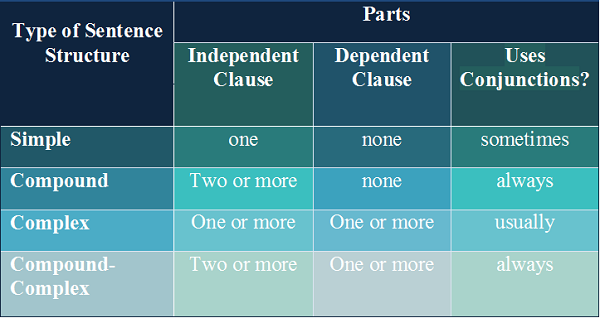
a. Simple sentence
A simple sentence has only one subject and one predicate—one independent clause. In fact, an independent clause itself is a simple sentence. Here are some examples:
- She jumped.
- The cheetah ran.
- He ran to the gas station.
- He ate dinner.
Simple sentences don’t have many details and they don’t really combine multiple ideas—they are simple!
b. Compound sentence
A compound sentence has at least two independent clauses. It uses a conjunction like “and” to connect the ideas. Here are some examples:
- The dog ate pizza but the cat drank apple juice.
- The dog ate pizza but the cat drank apple juice and the fish had eggs.
As you can see, a compound sentence allows us to share a lot of information by combining two or more complete thoughts into one sentence.
c. Complex sentence
A complex sentence has one independent clause and one or more dependent clauses. It sometimes uses conjunctions and other words to combine all of the clauses together.
- When he was on the airplane, the man bought cookies.
- When he was on the airplane, the man bought cookies, but not brownies.
A great way to make a sentence more detailed is by adding dependent clauses (which couldn’t be sentences on their own). So, complex sentences let us add information to simple sentences.
d. Compound-complex sentence
A compound-complex sentence has two or more independent clauses and at least one dependent clause—so, it uses conjunction(s) to combine two complete sentences and at least one incomplete sentence. Here is an example:
The girl smelled cookies, which were baking at home, so, she ran all the way there.
The result of combining the three clauses and the conjunction is a compound-complex sentence that is both informational and easy to understand. The independent clauses give the main information, and the dependent clause(s) give the details.
5. How to Avoid Mistakes
When it comes to making sure your sentence is clear and complete, having the right sentence structure is very important. A couple of common mistakes can happen when you forget how to use clauses or conjunctions in the right way, like run-on sentences and fragment sentences.
a. Run-on sentences
In simple terms, a run-on sentence is a sentence that is too long. For instance, if a writer forgets to use conjunctions, a sentence seems like it “runs on” for too long. For example:
The fox really liked pancakes, he ate them every day for breakfast, he couldn’t eat them without syrup and butter.
But, with the right conjunctions, this can be a normal compound sentence:
The fox really liked pancakes, so, he ate them every day for breakfast; but, he couldn’t eat them without syrup and butter.
As you can see, the new sentence is much easier to read and makes more sense.
b. Fragment (incomplete) sentences
A “fragment” is a small piece of something. So, a fragment sentence is just a piece of a sentence: it is missing a subject, a predicate, or an independent clause. It’s simply an incomplete sentence. Fragment sentences can happen when you forget an independent clause.
For instance, by itself, a dependent clause is just a fragment. Let’s use a couple of the dependent clauses from above:
- While he was at the dance What happened?
- If he eats chocolate Then what?
As you can see, each leaves an unanswered question. So, let’s complete them:
- While he was at the dance, the dog drank fruit punch.
- The dog will get a stomachache if he eats chocolate.
Here, we completed the fragment sentences by adding independent clauses (underlined), which made them into complex sentences.
Sentences: Simple, Compound, and Complex
A common weakness in writing is the lack of varied sentences. Becoming aware of three general types of sentences--simple, compound, and complex--can help you vary the sentences in your writing.
The most effective writing uses a variety of the sentence types explained below.
1. Simple Sentences
A simple sentence has the most basic elements that make it a sentence: a subject, a verb, and a completed thought.
Examples of simple sentences include the following:
- Joe waited for the train.
"Joe" = subject, "waited" = verb
- The train was late.
"The train" = subject, "was" = verb
- Mary and Samantha took the bus.
"Mary and Samantha" = compound subject, "took" = verb
- I looked for Mary and Samantha at the bus station.
"I" = subject, "looked" = verb
- Mary and Samantha arrived at the bus station early but waited until noon for the bus.
"Mary and Samantha" = compound subject, "arrived" and "waited" = compound verb
The use of compound subjects, compound verbs, prepositional phrases (such as "at the bus station"), and other elements help lengthen simple sentences, but simple sentences often are short. The use of too many simple sentences can make writing "choppy" and can prevent the writing from flowing smoothly.
A simple sentence can also be referred to as an independent clause. It is referred to as "independent" because, while it might be part of a compound or complex sentence, it can also stand by itself as a complete sentence.
2. Compound Sentences
A compound sentence refers to a sentence made up of two independent clauses (or complete sentences) connected to one another with a coordinating conjunction. Coordinating conjunctions are easy to remember if you think of the words "FAN BOYS":
- For
- And
- Nor
- But
- Or
- Yet
- So
Examples of compound sentences include the following:
- Joe waited for the train, but the train was late.
- I looked for Mary and Samantha at the bus station, but they arrived at the station before noon and left on the bus before I arrived.
- Mary and Samantha arrived at the bus station before noon, and they left on the bus before I arrived.
- Mary and Samantha left on the bus before I arrived, so I did not see them at the bus station.
Coordinating conjunctions are useful for connecting sentences, but compound sentences often are overused. While coordinating conjunctions can indicate some type of relationship between the two independent clauses in the sentence, they sometimes do not indicate much of a relationship. The word "and," for example, only adds one independent clause to another, without indicating how the two parts of a sentence are logically related. Too many compound sentences that use "and" can weaken writing.
Clearer and more specific relationships can be established through the use of complex sentences.
3. Complex Sentences
A complex sentence is made up of an independent clause and one or more dependent clauses connected to it. A dependent clause is similar to an independent clause, or complete sentence, but it lacks one of the elements that would make it a complete sentence.
Examples of dependent clauses include the following:
- because Mary and Samantha arrived at the bus station before noon
- while he waited at the train station
- after they left on the bus
Dependent clauses such as those above cannot stand alone as a sentence, but they can be added to an independent clause to form a complex sentence.
Dependent clauses begin with subordinating conjunctions. Below are some of the most common subordinating conjunctions:
- after
- although
- as
- because
- before
- even though
- if
- since
- though
- unless
- until
- when
- whenever
- whereas
- wherever
- while
A complex sentence joins an independent clause with one or more dependent clauses.
The dependent clauses can go first in the sentence, followed by the independent clause, as in the following:
- Because Mary and Samantha arrived at the bus station before noon, I did not see them at the station.
- While he waited at the train station, Joe realized that the train was late.
- After they left on the bus, Mary and Samantha realized that Joe was waiting at the train station.
Conversely, the independent clauses can go first in the sentence, followed by the dependent clause, as in the following:
- I did not see them at the station because Mary and Samantha arrived at the bus station before noon.
- Joe realized that the train was late while he waited at the train station.
- Mary and Samantha realized that Joe was waiting at the train station after they left on the bus.
Complex sentences are often more effective than compound sentences because a complex sentence indicates clearer and more specific relationships between the main parts of the sentence. The word "before," for instance, tells readers that one thing occurs before another. A word such as "although" conveys a more complex relationship than a word such as "and" conveys.
Periodic sentences can be especially effective because the completed thought occurs at the end of it, so the first part of the sentence can build up to the meaning that comes at the end.
Beginning Sentences with "And" or "Because"
Should you begin a sentence with "and" or "but" (or one of the other coordinating conjunctions)?
The short answer is "no." You should avoid beginning a sentence with "and," "or," "but," or the other coordinating conjunctions. These words generally are used to join together parts of a sentence, not to begin a new sentence.
However, such sentences can be used effectively. Because sentences beginning with these words stand out, they are sometimes used for emphasis. If you use sentences beginning with one of the coordinating conjunctions, you should use these sentences sparingly and carefully.
Should you begin a sentence with "because"?
There is nothing wrong with beginning a sentence with "because."
Perhaps some students are told not to begin a sentence with "because" to avoid sentence fragments (something like "Because Mary and Samantha arrived at the bus station before noon" is a sentence fragment), but it is perfectly acceptable to begin a sentence with "because" as long as the sentence is complete (as in "Because Mary and Samantha arrived at the bus station before noon, I did not see them at the station.")
Sentence structure refers to the physical nature of a sentence and how the elements of that sentence are presented. Just like word choice, writers should strive to vary their sentence structure to create rhythmic prose and keep their reader interested. Sentences that require a variation often repeat subjects, lengths, or types.
Related information about varying sentence structures can be found through these links:
Varying Subject or Word Choice
One of the easiest ways to spot text that requires variety is by noting how each sentence opens. Writers can often overuse the same word, like an author’s name, or a subject, like pronouns to refer to an author, when beginning sentences. This lack of subject variety can be distracting to a reader. Review the following paragraph’s sentence variety:
My philosophy of education is derived from my personal experiences. I have been an educator for 4 years, and I have learned a lot from more experienced teachers in my district. I also work mainly with students from a low socioeconomic background; my background was quite different. I will discuss how all of these elements, along with scholarly texts, have impacted my educational philosophy.
Notice how the writer of this paragraph starts each sentence and clause with a personal pronoun. Although the writer does alternate between “I” and “my”, both pronouns refer to the same subject. This repetition of personal pronouns is most common when writing a Personal Development Plan (PDP) or other personal papers. To avoid this type of repetition, try adjusting the placement of prepositional phrases or dependent clauses so the subject does not open each sentence:
My philosophy of education is derived from my personal experiences. Having been an educator for 4 years, I have learned a lot from more experienced teachers in my district. I also work mainly with students from a low socioeconomic background that is quite different from mine. In this paper, I will discuss how all of these elements, along with scholarly texts, have impacted my educational philosophy.
Varying Sentence Length
Another way to spot needed sentence variety is through the length of each sentence. Repeating longer sentences can inundate a reader and overshadow arguments, while frequently relying on shorter sentences can make an argument feel rushed or stunted.
Overusing Long Sentences
The company reported that yearly profit growth, which had steadily increased by more than 7% since 1989, had stabilized in 2009 with a 0% comp, and in 2010, the year they launched the OWN project, actually decreased from the previous year by 2%. This announcement stunned Wall Street analysts, but with the overall decrease in similar company profit growth worldwide, as reported by Author (Year) in his article detailing the company’s history, the company’s announcement aligns with industry trends and future industry predictions.
Notice how this paragraph is comprised of just two sentences. While each clause does provide relevant information, the reader may have difficulty identifying the subject and purpose of the whole paragraph.
Overusing Short Sentences
In 2010, the company’s yearly profit growth decreased from the previous year by 2%. This was the year they launched the OWN project. The profit growth had steadily increased by more than 7% since 1989. (They stabilized in 2009.) This announcement stunned Wall Street analysts. However, it aligns with the decrease in similar company profit growth worldwide. It also supports future predictions for the industry (Author, Year).
Notice how this paragraph uses the same information as the previous one but breaks it into seven sentences. While the information is more digestible through these shorter sentences, the reader may not know what information is the most pertinent to the paragraph’s purpose.
Alternating Sentence Length
Alternating between lengths allows writers to use sentences strategically, emphasizing important points through short sentences and telling stories with longer ones:
The company reported that profit growth stabilized in 2009, though it had steadily increased by more than 7% since 1989. In 2010, the year they launched the OWN project, company profit growth decreased from the previous year. This announcement stunned Wall Street analysts. According to Author (Year), however, this decrease was an example of a trend across similar company profit growth worldwide; it also supports future predictions for the industry.
Varying Sentence Type
One of the trickiest patterns to spot is that of repetitive sentence type. Just like subject and length, overusing a sentence type can hinder a reader’s engagement with a text. There are four types of sentences: simple, compound, complex, and compound-complex. Each sentence is defined by the use of independent and dependent clauses, conjunctions, and subordinators.
- Simple sentences: A simple sentence is an independent clause with no conjunction or dependent clause.
- Compound sentences: A compound sentence is two independent clauses joined by a conjunction (e.g., and, but, or, for, nor, yet, so).
- Complex sentences: A complex sentence contains one independent clause and at least one dependent clause. The clauses in a complex sentence are combined with conjunctions and subordinators, terms that help the dependent clauses relate to the independent clause. Subordinators can refer to the subject (who, which), the sequence/time (since, while), or the causal elements (because, if) of the independent clause.
- Compound-complex sentences: A compound-complex sentence contains multiple independent clauses and at least one dependent clause. These sentences will contain both conjunctions and subordinators.
Understanding sentence type will help writers note areas that should be varied through the use of clauses, conjunctions, and subordinators.
In her article, Author (Year) noted that the participants did not see a change in symptoms after the treatment. Even during the treatment, Author observed no change in the statements from the participants regarding their symptoms. Based on these findings, I will not use this article for my final project. Because my project will rely on articles that note symptom improvement, Author’s work is not applicable.
Notice how the writer relies solely on complex sentences in this paragraph, even placing dependent clauses at the beginning of each sentence. Here is an example of merely adjusting the placement of these dependent clauses but not the sentence type:
In her article, Author (Year) noted that the participants did not see a change in symptoms after the treatment. Author observed, even during treatment, no change in the statements from the participants regarding their symptoms. I will not use this article for my final project based on these findings. Because my project will rely on articles that note symptom improvement, Author’s work is not applicable.
While this change in the placement of dependent clauses does avoid a repetitive rhythm to the paragraph, try combining sentences or using conjunctions to create compound or compound-complex sentences to vary sentence type:
In her article, Author (Year) noted that the participants did not see a change in symptoms after the treatment. Author observed, even during treatment, no change in the statements from the participants regarding their symptoms, and based on these findings, I will not use this article for my final project. Because my project will rely on articles that note symptom improvement, Author’s work is not applicable.
Making these slight adjustments to sentence type helps the reader engage with the narrative rather than focus on the structure of the text. Adjusting your sentence type during a final revision is a great way to create effective prose for any scholarly document.
References
- ^ Huddleston, Rodney (1984). Introduction to the Grammar of English. Cambridge University Press. ISBN 978-0-521-29704-2.
- ^ a b Rozakis, Laurie (2003). The Complete Idiot's Guide to Grammar and Style. Alpha. pp. 167–168. ISBN 1-59257-115-8.
- ^ Scheib, Henry (1849). The Thought and Its Expression: A Grammar After the System Introduced Into the Best Schools of Germany.
- ^ "Compound Sentences".
- ^ "Homogenous members of a sentence (in Russian)".
- ^ Sinclair, Christine (2007). Grammar: Getting it Right. McGraw-Hill. ISBN 978-0-335-22008-3.
- ^ a b "Fragments". Pasco-Hernando State College. Retrieved 13 August 2021.
- ^ e.g. H. W. Fowler in Modern English Usage on BUT, p. 60 in the first edition.
- ^ The Chicago Manual of Style (16th ed.). Chicago: University of Chicago Press. 2010. p. 257. ISBN 978-0-226-10420-1.
- ^ a b Berry, Chris; Brizee, Allen (2006-08-31). "Runons – Comma Splices Fused Sentences". Archived from the original on June 12, 2018. Retrieved 2008-01-24.
- ^ a b "Run-on Sentences, Comma Splices". Retrieved 2008-01-24.
- ^ "English Grammar Lesson - Run-Ons! - ELC". ELC - English Language Center. 2017-05-19. Retrieved 2017-09-14.
- ^ Hairston, Maxine; Ruszkiewicz, John J; Friend, Christy (1998). The Scott Foresman Handbook for Writers (5th ed.). New York: Longman. p. 509. ISBN 9780321002488.
- ^ The American Heritage Dictionary of the English Language
Comments
Post a Comment